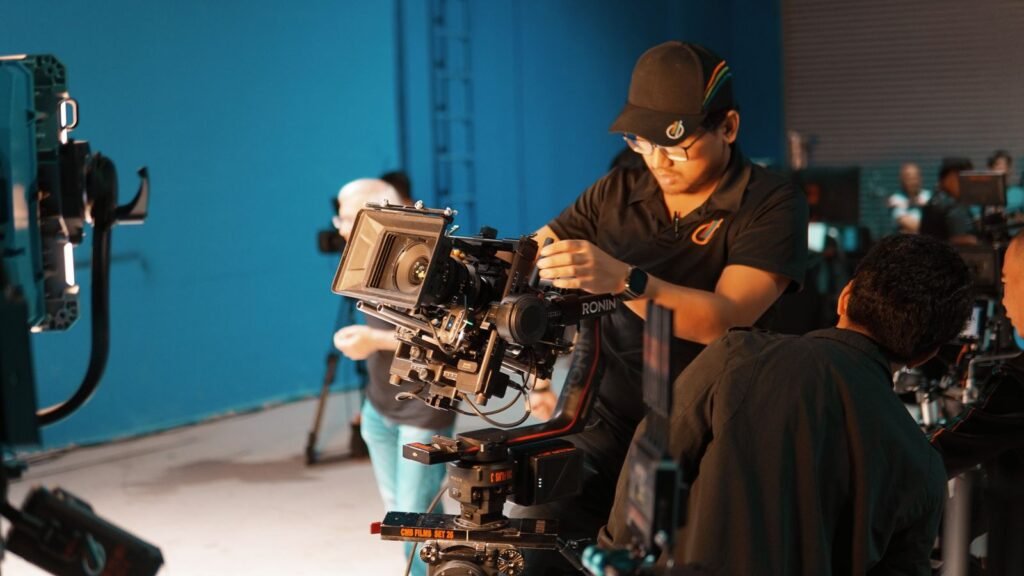
When we get a call that starts with "we need media production Singapore quotes," it is almost never a simple request. Half the time the business means a single explainer video. The other half they mean photography, audio, and a highlight reel from an event, all bundled under one phrase. That confusion is not the client's fault. Media production Singapore searches cover an unusually wide field of services, and most agency websites do not make the boundaries clear before asking for a budget.
In our experience, the confusion causes two real problems. Businesses either over-scope a brief and pay for services they do not need, or under-scope it and get a quote that balloons once the production house explains what is actually involved. This guide sets out what media production Singapore actually covers, what it costs in SGD at different tiers, and how to pick a partner without getting burned on either end.
We have also found that the businesses who get the best outcomes are not necessarily the ones with the biggest budgets. They are the ones who walk into the first conversation already knowing which of the six categories above they actually need, roughly what tier of vendor fits their budget, and what a fair turnaround time looks like for their format. The rest of this guide is built to get any Singapore business to that same starting point before they request a single quote.
What "Media Production Singapore" Actually Covers
Media production is an umbrella term, and depending on who you ask, it can include any combination of the following:
- Video production: corporate videos, product demos, explainer videos, testimonials, social media content, and advertisements.
- Photography: product photography, corporate headshots, event photography, and lifestyle brand imagery.
- Event videography: conference recaps, launch event coverage, and livestream production.
- Audio production: voiceovers, podcast editing, and jingle composition.
- Animation and motion graphics: explainer animations, data visualisations, and logo stings.
- Post-production: editing, colour grading, sound design, and subtitling.
Our team has found that most businesses searching for media production Singapore actually need two or three of these, not all six. A good production partner will ask enough questions in the first call to narrow that down before quoting, rather than sending a blanket rate card.
Video Production, Photography, and Full Media Production: Where the Lines Actually Sit
It helps to separate three terms that get used interchangeably in briefs but mean different things to a production house.
Video production is the narrowest of the three. It covers the filming and editing of moving footage: a single corporate video, a testimonial, a product demo, or a short social clip. A video production quote usually assumes one shoot day, one format, and a defined edit scope.
Photography is its own discipline with its own pricing logic, typically billed per shot list or per SKU set rather than per day, because the deliverable is a batch of stills rather than a single edited file. In our experience, businesses that try to fold photography into a video quote as an afterthought usually end up paying more than if they had scoped it separately from the start, because the lighting and framing needs for stills are not identical to the needs for video.
Full media production is the umbrella that combines several of these disciplines under one project, often with one producer coordinating video, photography, and sometimes animation or audio as a single deliverable set. This is the option most full-service houses are built around, and it is usually the right call once a brief has more than two distinct output formats, because a single coordinating producer removes the handoff gaps between separate vendors.
Knowing which of these three you actually need, before requesting quotes, is one of the fastest ways to get comparable proposals back from different vendors. A quote for "video production" and a quote for "full media production" are not the same thing, even when they are responding to what looks like the same brief.
The Contrarian Take: Your Biggest Cost Driver Is Not the Crew
Most guides on this topic focus on day rates: how much a camera operator costs, how much a photographer costs, how much editing costs per hour. We think that framing misses the real cost driver. In our experience quoting dozens of media production Singapore briefs, the single biggest swing factor in final cost is not crew size or equipment. It is how locked the pre-production brief is before anyone picks up a camera.
A business that arrives with a locked script, a shot list, a confirmed location, and signed-off talent will spend measurably less than a business that arrives with "we want something that looks professional." The second brief forces the production house to build in buffer time for reshoots, script rewrites mid-shoot, and last-minute location changes, and that buffer shows up in the quote whether or not it gets used. We recommend spending the extra week on pre-production even when the instinct is to rush straight to filming, because it is consistently the cheapest hour of the entire project.
What Media Production Actually Costs in Singapore (SGD)
Prices vary by scope, but the ranges below reflect what we typically see quoted in the Singapore market across freelancers, boutique studios, and full-service production houses. All figures are in SGD unless stated otherwise.
| Service | Freelancer (SGD) | Boutique Studio (SGD) | Full-Service House (SGD) |
|---|---|---|---|
| Corporate video (2-3 min) | SGD 1,500 to 3,000 | SGD 4,000 to 8,000 | SGD 10,000 to 25,000 |
| Product photography (per SKU set) | SGD 80 to 150 | SGD 150 to 350 | SGD 350 to 700 |
| Event videography (half-day) | SGD 800 to 1,500 | SGD 1,800 to 3,500 | SGD 4,000 to 8,000 |
| Explainer animation (60 sec) | SGD 1,200 to 2,500 | SGD 3,000 to 6,000 | SGD 8,000 to 15,000 |
| Full brand video campaign | Not typically offered | SGD 12,000 to 25,000 | SGD 30,000 to 60,000 |
A quick note on that comparison: freelancers are genuinely the right call for straightforward, single-deliverable jobs. Where we have seen businesses get burned is hiring a freelancer for a multi-part campaign that actually needed a small team, then paying twice once reshoots and coordination gaps show up. For context, equivalent full-service campaign production in the US market typically runs USD 25,000 to 50,000, so Singapore pricing at the full-service tier is broadly competitive on a currency-adjusted basis.
Client example: event video that helped a MICE company win more work
One MICE company we worked with ran corporate conferences and incentive trips in Singapore, where corporate clients want to see real events before they choose a partner.
We chose four upcoming events that showed the company's range, a regional sales conference, an awards gala, an incentive trip and a product launch, agreed filming permissions with each end client, and delivered same-day edits on site and highlight reels afterwards.
Five months in, the company received 9 proposal requests a month instead of 6 and won 33% of its proposals, up from 24%. Highlight reels averaged 5,800 views each on LinkedIn. Read the full MICE event videography case study.
A Typical Production Timeline, Week by Week
One reason costs vary so widely between vendors is that timelines get compressed differently depending on how organised the brief is. Here is roughly how a straightforward corporate video project runs when pre-production is handled properly.
Week 1: Briefing and scripting. The production house gathers brand messaging, confirms the target audience, and drafts a script or outline. We suggest treating this week as non-negotiable even when the launch date is tight, because every hour spent here saves multiple hours later.
Week 2: Pre-production. Locations are confirmed, talent is booked, shot lists are finalised, and equipment is scheduled. This is also when talent release forms should be signed, not on the day of the shoot.
Week 3: Filming. The actual shoot day, or days, happens here. A well-planned Week 1 and Week 2 typically means filming wraps in a single day for a standard corporate video. A rushed brief often means an extra half-day is added for reshoots discovered mid-edit.
Week 4: Editing and first cut. The production house delivers a rough cut for review. This is where most of the back-and-forth happens, and it is also where unclear revision terms tend to surface as a problem if they were not agreed upfront.
Week 5: Revisions and final delivery. One round of revisions is standard in most Singapore production contracts. Additional rounds usually incur extra charges, which is another reason we recommend clarifying this before signing rather than after the first cut lands.
Event videography and photography-only briefs compress this timeline considerably, since there is no scripting phase and the shoot date is fixed by the event itself rather than by production scheduling.
How to Choose a Media Production Partner
We suggest working through the following checklist before signing with any production house:
- Ask for a scoped shot list, not just a day rate. A partner who quotes based on a locked shot list is telling you they have actually planned the shoot. A partner who quotes purely on crew-hours is signalling a looser process.
- Check the portfolio for your specific format. A studio with excellent wedding photography is not automatically strong at corporate video. Ask for three examples in the exact format you need.
- Clarify revision rounds up front. In our experience, unclear revision terms are the single most common source of scope disputes after delivery.
- Confirm who owns the raw footage. Some studios retain raw files and only hand over the final edit. If you may want to re-cut content later, negotiate raw file ownership into the contract now.
- Ask how they handle reshoots. A partner who has a stated reshoot policy has clearly done this before. A partner who has never needed to answer the question has probably not been challenged on it yet.
- Get the turnaround time in writing. Post-production timelines slip more often than filming dates. We recommend building in a buffer week before any campaign launch date that depends on delivery.
We have found that businesses who go through this checklist before requesting quotes end up with proposals that are easier to compare, because every production house is responding to the same defined brief instead of guessing at scope.
Field Notes
Across four events we filmed for a MICE company over five months, proposal requests rose from 6 to 9 a month and the proposal win rate from 24% to 33%; highlight reels averaged 5,800 views each on LinkedIn.
Common Mistakes That Push Costs Up
A few patterns show up again and again in briefs that come in over budget:
- No locked script before filming. Every unscripted decision made on set costs more than the same decision made on paper the week before.
- Underestimating the need for talent releases. If real customers or staff appear on camera, releases need to be signed before the shoot, not chased afterward.
- Treating social cutdowns as free add-ons. Vertical and square cutdowns from a horizontal master often need separate framing and colour work, not just a crop.
- Skipping a brand or messaging brief. A production house without clear positioning guidance will default to generic stock-style choices, which usually means a reshoot later once marketing reviews the cut.
Most of these are avoidable with an extra planning conversation before the first quote is even requested, which loops back to the contrarian point above: the planning hour is the cheapest hour on the entire project.
Where Media Production Fits Into a Wider Marketing Plan
Media production rarely sits on its own. The video and photography assets a production house delivers usually need a home: a website design refresh to actually showcase the new footage, a social media marketing plan to distribute the cutdowns, and a content marketing calendar to make sure the assets are not filmed once and forgotten in a shared drive.
We typically advise clients to brief production and distribution at the same time, not sequentially. A brand that books a shoot without first confirming where the footage will run tends to end up with beautifully produced video that never gets a proper media push. If SEO is part of the plan, video and photography assets also need to be optimised for search from day one, including file names, alt text, and structured data, rather than retrofitted after publishing.
For businesses that specifically need photography or event coverage rather than full video production, it is worth looking at dedicated photography services or event videography packages rather than a full campaign build, since the pricing and turnaround for those formats are structured differently from a scripted brand video.
Frequently Asked Questions
How long does media production take in Singapore, from brief to delivery?
A single corporate video typically takes 3 to 5 weeks from brief to final delivery, including one round of revisions. Event videography turns around faster, usually 1 to 2 weeks post-event, since there is no scripting phase involved.
Is it cheaper to hire a freelancer or a full-service production house?
Freelancers are usually cheaper per deliverable, but a full-service house is often better value for multi-part campaigns because the coordination cost is bundled into the quote rather than absorbed by the business internally.
Do I need a separate photographer if I already have a videographer booked?
Not always. Many boutique studios in Singapore offer combined video and photography packages using the same crew and lighting setup on one shoot day, which is usually cheaper than booking two separate vendors for the same event.
What should be in a media production brief before requesting quotes?
At minimum: a locked script or shot list, confirmed locations, a talent list with release status, the required deliverable formats (horizontal, vertical, square), and a target delivery date. Our team has found that briefs missing even one of these items are the ones most likely to see cost creep during production.
Does media production Singapore pricing include usage rights?
Not always by default. Many quotes cover a limited usage term, such as social media and website use for 12 months, with paid extensions for broadcast or extended usage. We recommend confirming usage rights in writing before signing, since this is one of the most commonly disputed line items after delivery.
Should a small business handle media production in-house instead of hiring an agency?
For very simple, low-stakes content, an in-house smartphone setup can work. Once a brand is producing anything customer-facing at scale, such as paid ad creative or a full product launch, we typically find the coordination and quality gap between in-house and professional production widens quickly, and the cost of a reshoot after a paid campaign has already launched is almost always higher than the original production quote would have been.
Why Production Assets Also Need an SEO and Distribution Plan
A finished video or photography set is only as valuable as the audience that actually sees it. We have seen well-produced campaigns underperform simply because nobody planned where the assets would live or how they would be found. Video hosted on a slow, poorly structured page rarely ranks, and photography without proper file naming and alt text adds little to organic visibility even if the images look great.
If ecommerce product photography is part of the brief, it is worth pairing production planning with a look at how the site actually presents those images. Our ecommerce website design team regularly works alongside production briefs to make sure new photography and video assets slot into product pages correctly rather than sitting in a media library unused. For brands leaning on creator or influencer content alongside their own production, our influencer marketing team can help plan how newly produced assets are seeded through creator partnerships rather than only through owned channels.
Getting Started
Media production Singapore is a broad category, and the right partner depends entirely on what is actually being filmed, how it will be distributed, and how tightly the brief is scoped before the first quote goes out. If your business is weighing up a freelancer against a full-service house, or trying to work out whether a bundled package makes more sense than piecing services together, our production team can walk through the brief with you before you commit to a quote.
If production is part of a wider push and you are also weighing up digital marketing support to make sure the finished assets actually reach an audience, our team is happy to scope both at once. You can find more about how we work on our about page, or reach out directly through our contact page to discuss your brief.
Whatever stage you are at, get the pre-production brief locked before requesting quotes. It is the one step in this entire process that consistently pays for itself, and in our experience it is still the step most businesses skip. If you would like a second opinion on a quote you have already received, our contact page is the fastest way to reach us.

Natasha Tan is the founder of Digital Marketing Singapore, a full-service SEO and digital marketing agency based in Singapore. With hands-on experience across SEO, paid media, and content strategy, she works directly with Singapore businesses to build organic visibility and generate consistent leads. Natasha specialises in the Singapore market — including local search behaviour, PDPA compliance, and government grant navigation for SMEs.