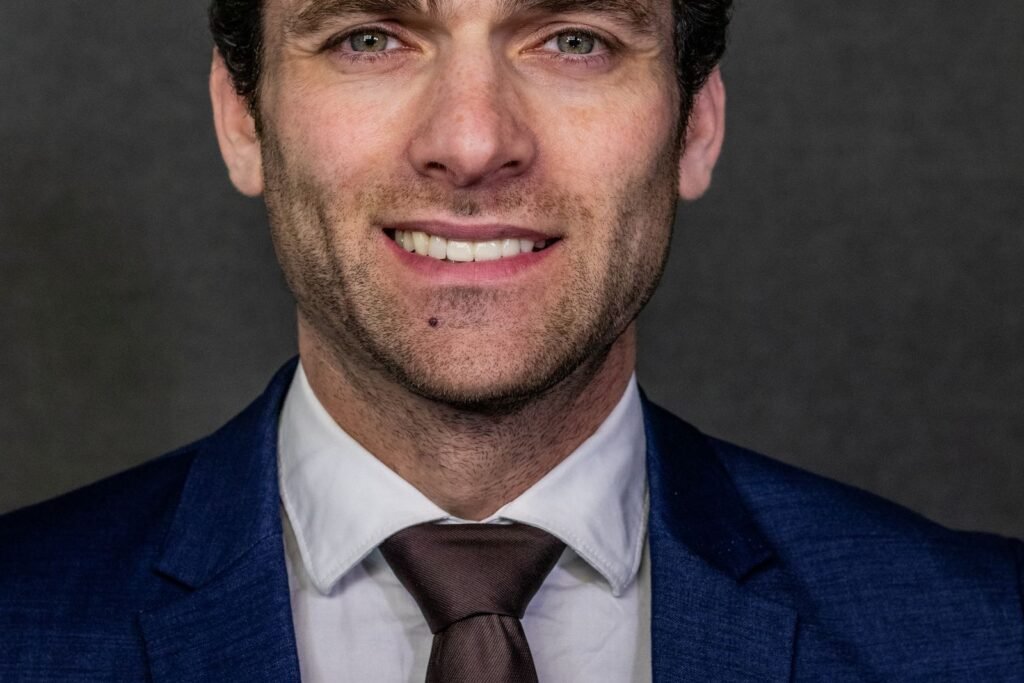
Walk through the leadership page of almost any mid-sized Singapore company and you will see the same thing. Four photographs taken on the same day in 2021 against a white wall, two taken two years later against a window, one cropped out of a wedding, and one that is clearly a phone selfie with the background blurred. A corporate headshot Singapore businesses commission is usually treated as a one-off event, and that single decision is why team pages look like a collage instead of a company.
The fix is not a better photographer, though that helps. The fix is treating headshots as a standard with a documented specification, a refresh cycle and a process for new joiners, in the same way you treat your logo files or your email signature template. Photography is the easy part. Consistency over time is the hard part, and it is the part almost nobody plans for.
This post covers how to set that standard, what the technical specification should actually say, how to handle remote and overseas staff, when to refresh, and how to get usable files for LinkedIn, the website and printed materials from one session.
Why consistency matters more than individual quality
An individual portrait is judged on its own merits. A team page is judged as a set. The eye picks up inconsistency immediately, long before it evaluates whether any single photograph is good.
Three things create the impression of a mismatched set, in order of how noticeable they are:
Background. Different colours or different tones read as different companies. This is the most jarring inconsistency and the easiest to control.
Crop and head size. If one person's head occupies 40 percent of the frame height and the next occupies 25 percent, the grid looks broken even when both images are individually well made. Framing standards matter more than most briefs acknowledge.
Lighting direction and contrast. Soft, flat, frontal light next to dramatic side light with deep shadow reads as two different eras of the business.
Colour grading, wardrobe and expression matter too, but they are second order. Get background, crop and lighting aligned and a set will hold together even when the images were taken years apart by different people.
In our experience, the businesses that get this right are the ones that wrote it down. The ones that did not write it down have drifted within eighteen months, without exception, because the person who remembered the original setup has moved on.
The specification, written out
This is the sort of document we hand over at the end of a session so the standard survives staff turnover. Adapt the values, keep the structure.
| Element | Recommended standard | Why it matters |
|---|---|---|
| Background | Single named colour, mid grey or brand neutral, matte, non-reflective | Most visible inconsistency; hardest to fix afterwards |
| Lighting | Large soft key at 45 degrees, fill at 2:1 ratio, no hard shadow on background | Keeps skin tone rendering consistent across sessions |
| Lens and distance | 85mm to 135mm equivalent, roughly 2 metres subject distance | Prevents facial distortion; keeps proportions matched |
| Crop, primary | Mid chest to just above the head, head height about 30 percent of frame | The version used on team grids and bios |
| Crop, square | 1:1 centred, eyes on upper third | LinkedIn, Teams, internal directories |
| Crop, wide | 16:9 with negative space on one side | Website banners, slide headers, press use |
| Orientation of subject | Body angled slightly, face to camera | Softens the mugshot effect without breaking the set |
| Wardrobe guidance | Solid colours, no fine stripes or busy patterns, sleeves for all | Fine patterns moire on screen; keeps formality level even |
| File delivery | Full resolution TIFF or high quality JPEG plus web-sized JPEG under 300KB | Print and web needs differ; avoid uploading 8MB files to your site |
| Colour profile | sRGB for web, Adobe RGB master retained | Prevents dull or shifted colour after upload |
| Retouching level | Blemish and stray hair removal only; no reshaping | Consistency and credibility; avoids dated over-retouched look |
That last row causes more debate than any other. We recommend a light touch and we recommend applying the same level to everyone, because unequal retouching across a team is both visually obvious and, in a workplace context, a genuine fairness issue.
Getting the same look for remote and overseas staff
Singapore teams increasingly include people who are not in the office. Regional sales staff, engineers in another market, contractors, and colleagues who come in twice a month. This is where most headshot standards break down.
There are three workable approaches and one that does not work.
Approach one: the travelling standard. You document the setup precisely, including the exact backdrop colour reference, light modifier size, distance and camera settings, and brief a local photographer in each market to match it. This works well when the specification is genuinely detailed. It fails when the brief says "plain grey background, professional lighting", because that phrase describes about forty different results.
Approach two: the composite background. You shoot everyone against a clean, evenly lit background of any neutral colour, then cut out and place them on a single standard background in post production. Technically straightforward if the lighting on the subject is broadly similar and the edges are clean. It falls apart with fine flyaway hair under poor lighting, so it needs a competent operator at both ends.
Approach three: the batching schedule. You simply do not photograph remote staff individually. You hold the slot until they are next in Singapore for a company event or a planning week, and you photograph everyone in one run. This is what we usually recommend, because it is cheaper, more consistent and creates a natural rhythm.
What does not work is asking staff to send in whatever they have. We have watched several businesses try this, and the outcome is a team page with two studio portraits, one image cropped from a group photo and one taken in a car park. If you are going to have a standard, you cannot have an exception route that bypasses it.
For staff who cannot be photographed for months, use a consistent placeholder treatment, such as an initial tile in a brand colour, rather than a mismatched photo. A missing photograph looks intentional. A wrong one looks careless.
A refresh policy that people will actually follow
Most companies refresh headshots when someone finally complains that the CEO's photo is a decade old. A policy avoids that.
Here is the structure we suggest, and the reasoning behind each part.
Company-wide refresh every three years. Long enough that it is not a burden, short enough that images do not become conspicuously dated. Hairstyles, glasses and the general look of photography all shift noticeably over three years. Put it in the marketing calendar as a recurring event, not as a project.
New joiner sessions quarterly. Batch new staff into a session every three months. A standing half day, four times a year, with a named owner in HR or marketing. This is the most effective habit, and it is also the one most frequently abandoned after the second quarter.
Trigger-based updates. A significant change in appearance, a promotion into a client-facing or spokesperson role, or a move into leadership all justify an individual update outside the cycle.
A hard rule on retirement. When someone leaves, their photo comes down within a defined window. We suggest five working days. It sounds administrative, but outdated leadership pages are a credibility problem, particularly for professional services firms where prospects check who they will actually be working with.
The economics favour batching heavily. A half day on-site session covering fifteen to twenty people costs meaningfully less per head than four separate individual bookings across the same year, and it produces a better matched set. We have seen the per-person cost move from roughly SGD 250 for ad hoc individual sessions down to under SGD 100 per head on a properly batched half day, for a better result. Those figures will vary with the photographer and the scope, but the direction is consistent.
Where the photographs actually get used
Brief the session around the uses, not around the aesthetic. A set of beautiful portraits that do not crop to square is a set you will be re-shooting.
LinkedIn profiles. Square, displayed small and often circular. The crop must survive a circular mask without cutting the top of the head or the chin. This is the most-viewed version of the photograph by a wide margin, and it deserves to be the primary crop consideration rather than an afterthought. It also matters commercially, because for most B2B firms the personal profiles of the team carry more reach than the company page, which is why we treat it as part of a broader LinkedIn marketing approach rather than a pure photography deliverable.
Website team and bio pages. Usually a grid, sometimes with a hover state or a circular mask, sometimes rectangular. Confirm the shape and aspect ratio with whoever builds the site before the shoot, not after. This single conversation prevents most re-crops, and it is a standard part of how we scope user experience design work on a site with a substantial people section.
Proposals, decks and tenders. Often printed or projected. These need the full resolution files and a version with enough surrounding space to place over a coloured panel.
Press, speaker bios and event listings. Frequently requested at short notice and frequently requiring a landscape or wide crop. Having one ready avoids the scramble.
Email signatures and internal directories. Small, square, heavily compressed. Make sure a properly optimised small version exists rather than letting each department resize badly.
Bylined content. If your specialists write articles or appear as quoted experts, their portrait travels with the content. Where we pair headshots with a copywriting programme for a professional services client, we ask for the wide crop specifically for article headers.
Ask for all crops at the time of delivery. Going back six months later for a different aspect ratio is possible but rarely free.
The contrarian view: your team page does not need portraits at all costs
A common mistake we see is a business spending heavily on a full team shoot when the commercial problem sits somewhere else entirely.
In reality, headshots move the needle in a narrow band of situations. They matter enormously when the buyer is choosing a person rather than a product: law, accounting, consulting, recruitment, financial advisory, agencies, clinics, real estate. In those categories the team page is often the second or third most visited page on the site and the photographs are doing real persuasive work.
They matter far less for a product ecommerce business, a logistics operator or a manufacturer where nobody browses the staff list before buying. We have reviewed analytics for businesses where the team page received under one percent of site sessions, and the proposed spend on portraits was several times the annual budget for the pages that actually generated enquiries.
Corporate portraits are one of the easier things to approve internally. Everybody understands what they are buying, the deliverable is tangible, and the output is pleasant to look at. Harder, less photogenic work, such as rewriting the service pages or fixing the enquiry form, tends to lose the internal argument.
So check the analytics first. If the team page is being read, invest properly and do it consistently. If it is not, do a lean, competent set of the client-facing people and put the remainder into whichever production work actually supports the sale, which for many businesses is closer to product imagery or short-form video than portraiture.
One Singapore firm's experience
One Singapore professional services firm we worked with had grown from eleven people to thirty four over four years without ever repeating their original shoot. Their team page had three visually distinct groups of photographs, and their proposal documents were worse, because partners had substituted whatever file they had to hand.
The immediate trigger was a tender. A client-side procurement team had commented on the inconsistency of their submitted team profiles, which is a small comment with an uncomfortable implication about attention to detail.
We did not simply re-shoot everyone. We started by documenting a specification, then scheduled a single on-site day using a meeting room with the blinds closed and controlled lighting, photographing twenty nine people in around seven hours with a booking sheet in fifteen minute slots. Five remote colleagues were photographed six weeks later on the same setup during a company offsite. Everyone received five crops: square, portrait, wide, a transparent background cut-out for decks, and a compressed web version.
The part that mattered most was not the shoot. It was the handover: a one page specification sheet, the named backdrop colour, the lighting diagram, and a standing calendar entry for a quarterly new joiner session with a named owner. Eighteen months later the set still matched, because new hires were being photographed to the same standard within three months of starting.
The commercial outcome we can honestly claim is modest and specific: their proposal documents stopped looking assembled. That is worth something in a tender process, and it cost less than a single month of their paid media budget.
Practical notes on running the session
A few things that consistently improve the day.
Book fifteen minute slots, not ten. Ten minutes works on paper and collapses the moment someone arrives flustered from a call. Fifteen gives room for a short conversation, which is what produces a natural expression.
Send wardrobe guidance a week ahead and again the day before. Solid colours, avoid fine stripes and small checks, bring a second option, and mention that people often prefer a jacket for a formal crop and no jacket for the LinkedIn version.
Shoot both versions where relevant. Jacket and no jacket, or smiling and neutral. It costs almost no additional time in the session and saves a re-shoot when the brand tone shifts.
Have a mirror and a lint roller in the room. Unglamorous and extremely effective.
Nominate a coordinator who is not the photographer. Somebody internal to chase people, manage the running order and handle the inevitable reschedules. Sessions that run late almost always run late for scheduling reasons, not photographic ones.
Agree the selection process before the day. Who picks the final frame, the individual or the marketing lead? Decide in advance. A shoot with thirty subjects and no selection process generates a week of email.
Choose the room carefully. The best room for a portrait session is rarely the nicest room in the office. You want depth behind the subject, a door that closes, and control over the ambient light. A meeting room with a window running the length of one wall is difficult, because the daylight changes over the course of the day and the later portraits will not match the earlier ones. A slightly dull internal room with the blinds shut and controlled artificial lighting will give a far more consistent set. We check this during the recce rather than on the morning itself, because discovering the light problem at nine o'clock with twenty people booked is not a situation anybody enjoys.
Plan the running order around meetings, not seniority. The traditional instinct is to photograph the leadership team first. In practice it is better to schedule around people's diaries and put anybody with a hard external commitment early, because they are the ones who cannot be moved. Leadership can usually be flexible by fifteen minutes. A sales director with a client call cannot.
Decide the expression brief in advance. There is a real difference between a warm, open smile and a composed, neutral expression, and the right answer depends on the sector. Professional services and financial firms often prefer composed. Consumer, hospitality and healthcare businesses usually want warmth. What you should avoid is a set where half the team is smiling broadly and half is not, because that reads as indecision rather than range. Pick one register, tell everyone in advance, and capture a small number of alternates for people who need a different tone for a specific use.
If your session is happening alongside other content capture, such as office environment shots or interview footage for corporate video production, sequence the portraits first while people are fresh and the lighting is already set. The same logic applies when portraits sit inside a larger capture day for an event videography brief, where the schedule is tighter and the portrait station needs its own dedicated corner.
Field Notes
Across the corporate photography briefs we handled for Singapore clients over the past year, the average team had headshots from 3 separate sessions on their website at the same time, and in the worst case we counted photographs spanning 6 calendar years on a single team page. The businesses that had a written specification, which was a minority, averaged just over one.
The other number worth reporting: on a batched on-site day we typically photograph between 18 and 24 people in a single half day at 15 minute intervals, including setup and a lunch gap. Companies planning their first shoot almost always over-estimate the time needed per person and under-estimate the time lost to people not turning up on schedule. Build in 2 empty slots per half day for stragglers and you will finish on time.
Making it stick
The photography is a day. The standard is a habit. Write the specification down, name an owner, put the quarterly new joiner session in the calendar before you leave the shoot, and agree the removal rule for leavers.
If you want help setting a standard that will still hold in three years, our corporate photography team scopes these sessions around the crops and uses first, and this kind of consistency work also feeds directly into how a business presents itself for brand awareness purposes. Tell us how many people you have and where they sit through our contact page and we will map out a realistic schedule.

Natasha Tan is the founder of Digital Marketing Singapore, a full-service SEO and digital marketing agency based in Singapore. With hands-on experience across SEO, paid media, and content strategy, she works directly with Singapore businesses to build organic visibility and generate consistent leads. Natasha specialises in the Singapore market — including local search behaviour, PDPA compliance, and government grant navigation for SMEs.