Quick answer: Event videography Singapore clients book usually falls into one of three tiers: a single operator for small internal events, a two-to-three person crew for conferences and product launches, and a full multi-camera team with a dedicated editor for gala dinners, weddings, and brand campaigns. What changes the outcome is not the number of cameras on the day, it is the quality of the pre-production brief and the hours budgeted for editing afterwards. This guide walks through what to expect at each stage, how to plan a shoot that will not fall apart on the day, and what a realistic Singapore budget looks like in 2026.
What "Event Videography" Actually Covers in Singapore
Before booking anything, it helps to separate "event videography" from adjacent services it often gets bundled with, such as livestreaming, drone filming, or straightforward photography. A production house may offer all of these, but they are priced and crewed differently. Livestreaming needs a dedicated encoder operator and a stable venue internet connection tested in advance; drone filming in Singapore requires separate permits from the Civil Aviation Authority of Singapore for most public and many private sites, which needs to be arranged weeks ahead, not the week of the event; and photography, while it can run alongside video, is a genuinely separate discipline best planned with its own brief rather than treated as a bonus add-on to a video booking.
Event videography is often lumped in with wedding filming or general video production, but in a Singapore context it covers a much wider range of work: annual dinners and town halls, product launches at retail spaces, conferences at Suntec or the Sands Expo, corporate anniversaries, investor days, F&B openings, and brand activations at malls or void decks. Each of these has a different rhythm. A conference has a fixed run of show and predictable stage segments. A product launch has a compressed 20-minute window where everything that matters happens at once. A void deck activation has no stage at all, and the story has to be found in the crowd.
In our experience working across these formats, the biggest planning mistake companies make is treating all three the same way and briefing a videographer with a single line: "just cover the event." That brief works for nobody. A camera operator without a shot list will default to safe, wide, static coverage, which is the least interesting footage you can produce and the hardest to edit into anything usable for social media marketing afterwards.
Singapore's venue landscape also shapes what "coverage" even means. A ballroom shoot at a hotel on Orchard Road has controlled lighting, a fixed stage, and a predictable seating plan, so the crew can pre-plan almost every angle. A rooftop launch or an outdoor activation at a park connector has changing light, wind noise on lavalier mics, and a crowd that moves unpredictably, so the crew has to work reactively instead of to a fixed plan. Conference centres such as Suntec or the Sands Expo and Convention Centre sit somewhere in between: the stage is fixed, but breakout rooms and expo floors add a second layer of coverage that a single crew often cannot handle alone. Knowing which category an event falls into before booking is one of the simplest ways to avoid mismatched expectations between the client and the production team.
What to Expect: The Three Phases of a Shoot
1. Pre-Production: The Brief, the Recce, and the Shot List
A properly planned event videography project in Singapore starts one to three weeks out, not the day before. Expect your videographer to ask for: the run of show with timings, a floor plan or venue layout, a list of "must-have" moments (the CEO's speech, the ribbon-cutting, the award announcement), and any brand guidelines that affect how footage will be color graded or captioned. For larger venues, a site recce is worth the half-day it costs. Lighting rigs at Suntec ballrooms, for example, behave very differently from the natural light of an outdoor rooftop launch, and a crew that has not seen the room will lose time on the day adjusting for it.
2. Production Day: Crew Roles and Coverage
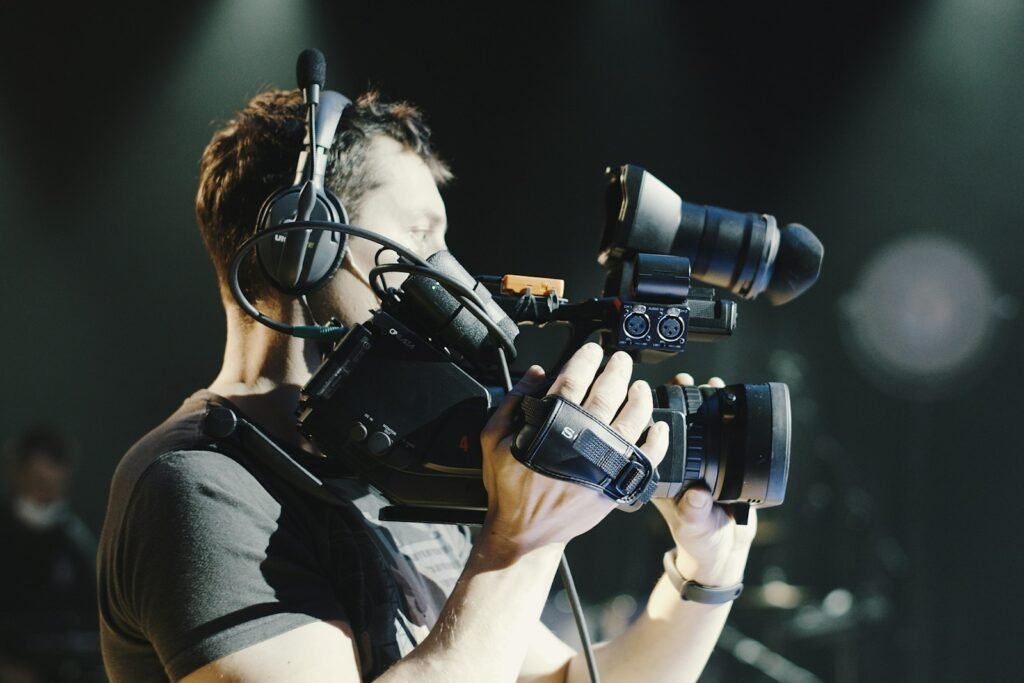
On the day itself, expect defined roles rather than a single person trying to do everything. A typical two-person crew splits into a "safety" camera on a tripod, which captures a continuous wide shot of the stage as insurance, and a "story" camera on a gimbal or shoulder rig, which moves through the room for cutaways, reactions, and detail shots. Add a third operator for events with breakout rooms or multiple simultaneous activities, such as a conference with parallel tracks. Audio is where most in-house teams cut corners; expect a proper video professional to bring a wireless lavalier or boom setup rather than relying on the venue's PA feed, which is almost always compressed and unusable for anything beyond a rough cut.
3. Post-Production: Where the Real Work Happens
This is the phase clients underestimate the most. A 2-hour event typically generates 4 to 8 hours of raw footage across two cameras, and turning that into a 3-minute highlight reel plus a set of 15 to 30-second social cutdowns is not a quick trim job. Expect a proper edit to include a rough cut for client review, at least one round of revisions, colour correction, audio levelling, motion graphics for titles and lower thirds, and export in the aspect ratios you actually need (16:9 for a website or YouTube, 9:16 for Instagram Reels and TikTok, 1:1 for LinkedIn and Facebook feed posts). We recommend budgeting at least three working days for post-production on a standard corporate event, and closer to two weeks for a wedding or a multi-day conference.
How to Plan an Event Videography Shoot That Does Not Fall Apart
Planning an event videography shoot in Singapore comes down to five decisions, made in this order:
- Define the deliverable first, not the crew size. Do you need a 3-minute recap for a company town hall, or twelve short-form clips for a brand's social channels? The deliverable determines the shot list, which determines the crew.
- Confirm the venue's technical constraints early. Some Singapore venues restrict tripod placement in aisles, ban flash photography during ceremonies, or require a certificate of insurance before crew are allowed on the premises. Confirm this at least a week out, not on the morning of the event. Some venues also require crew to be listed on a visitor or vendor pass in advance, which can take longer to process than expected during busy conference seasons.
- Build a realistic timeline, including buffer. Events almost never run to the printed schedule. A CEO speech scheduled for 15 minutes routinely runs to 22. Brief your crew on which moments are non-negotiable so they can protect the shot even if the schedule slips.
- Agree on the turnaround before the event, not after. "Fast" means different things to different production houses. Some can turn around a same-day highlight clip for social media if that is booked and briefed in advance; a fully graded, multi-format final deliverable is a different timeline entirely.
- Loop in your other marketing channels before the shoot, not after the footage is edited. If the video is meant to support a content marketing push or a digital marketing campaign, the team running that campaign should have input into the shot list before the event, not just the final cut.
Client example: event video that helped a MICE company win more work
One MICE company we worked with ran corporate conferences and incentive trips in Singapore, where corporate clients want to see real events before they choose a partner.
We chose four upcoming events that showed the company's range, a regional sales conference, an awards gala, an incentive trip and a product launch, agreed filming permissions with each end client, and delivered same-day edits on site and highlight reels afterwards.
Five months in, the company received 9 proposal requests a month instead of 6 and won 33% of its proposals, up from 24%. Highlight reels averaged 5,800 views each on LinkedIn. Read the full MICE event videography case study.
The Contrarian Truth About Event Videography Budgets
The most common misconception we hear from Singapore event organisers is that more cameras on the day automatically means better coverage. In our experience, the opposite is often closer to the truth. A three-camera crew with no shot list and a rushed brief will produce three times the raw footage to sift through, with no guarantee any of it is more usable than a well-briefed two-camera setup. What actually moves the needle on quality is not camera count, it is the hours spent in pre-production briefing and the hours spent in post-production editing. Our clients who get the best results are consistently the ones who shift budget away from "one more camera operator" and toward "one more day of editing," because that is where a highlight reel actually gets built, not on the day itself.
Event Videography Pricing in Singapore: A Comparison
Pricing varies by crew size, event length, and turnaround speed. The figures below are indicative market ranges based on typical Singapore production briefs in 2026, not a fixed DMS rate card, and should be used as a planning benchmark rather than a quote.
| Crew Setup | Best For | Typical Half-Day Rate (SGD) | Typical Turnaround |
|---|---|---|---|
| Solo videographer | Small internal events, simple recap videos | SGD 600 to SGD 900 | 5 to 7 working days |
| Two-person crew | Conferences, product launches, awards dinners | SGD 1,200 to SGD 2,000 | 3 to 5 working days |
| Three-plus crew with dedicated editor | Galas, weddings, multi-day conferences, brand campaigns | SGD 2,500 to SGD 4,500 | 7 to 14 working days |
A note on comparing quotes: a lower half-day rate that excludes a wireless mic, a second camera angle, or more than one round of edit revisions is not actually cheaper once you add those back in. We recommend asking every vendor for a like-for-like breakdown of what is included before comparing SGD figures side by side.
How to Choose an Event Videography Partner in Singapore
Most companies choosing between production houses end up comparing day rates side by side, which is the least useful comparison to make. In our experience, the questions below surface far more useful differences between vendors than the quote alone:
- Ask to see a full edited project, not just a highlight reel. Highlight reels are, by definition, the best ten seconds of a shoot. Ask for a complete recap video from a similar event type so you can judge pacing, audio quality, and how well the story holds together for longer than a showreel clip.
- Ask who is actually on site on the day. Some studios sell the project and then subcontract the shoot to a freelance crew you have never met. That is not necessarily a problem, but you should know it in advance so you can brief the actual operators, not just the account manager.
- Ask how revisions are handled. Confirm how many rounds of edit feedback are included before extra rounds are billed separately, and get the answer in writing before the event, not during the edit.
- Ask about backup equipment and backup crew. A single point of failure, whether that is one camera, one memory card, or one operator, is a real risk for a one-off event that cannot be reshot. A professional crew should have a backup plan for equipment failure and, ideally, illness or last-minute cancellation.
- Ask how footage is delivered and for how long it is kept. Confirm the file formats, the delivery method for large video files, and how long raw and edited footage will be archived after the project closes, since re-requesting a cut six months later is far easier if the studio still has the files.
Our clients who go through this checklist before signing off on a production partner consistently report fewer surprises on the day and fewer awkward conversations about scope once the invoice arrives.
Common Mistakes to Avoid
Most of the issues we see after the fact trace back to a handful of avoidable decisions made weeks before the event, not problems with the crew on the day itself. In our experience, the five below account for the large majority of post-event frustration:
- Booking crew before defining deliverables. Deciding you need "a videographer" before deciding what the final video needs to do puts the cart before the horse.
- Skipping the venue recce for large or unfamiliar spaces. Lighting and sightline surprises on the day cost far more time than a half-day site visit beforehand.
- Relying on the venue's house audio feed. PA system audio is built for the room, not for video, and it rarely sounds usable once it is pulled into an edit.
- Under-budgeting post-production. As covered above, the edit is usually where more time is needed, not the shoot day.
- Not briefing for vertical formats. If clips are going on Instagram Reels or TikTok, the crew needs to know that before the event, not after, so they can frame shots that will not need an awkward crop later.
Field Notes
Across four events we filmed for a MICE company over five months, proposal requests rose from 6 to 9 a month and the proposal win rate from 24% to 33%; highlight reels averaged 5,800 views each on LinkedIn.
Frequently Asked Questions
How far in advance should I book event videography in Singapore?
For a standard corporate event, two to four weeks out gives enough time for a proper brief, a recce if needed, and crew availability. For peak season (the last quarter of the year, when annual dinners and galas cluster together), we recommend booking six to eight weeks ahead.
Do I need a separate photographer as well as a videographer?
For most events, yes. A videographer moving for continuous coverage and a photographer working in still frames are solving different problems, and one person trying to do both usually does neither well. If budget only allows one, prioritise based on the deliverable: video for a recap reel and social clips, photography for a press release or event photography gallery.
What footage should I own the rights to?
Confirm usage rights before the shoot, not after. Standard practice for a corporate booking includes internal use and owned social channels; broader usage such as paid advertising or resale to a third party should be discussed and priced separately.
Can event videography be integrated into a wider marketing campaign?
Yes, and this is where the biggest missed opportunities are. Footage from a single well-planned event can be cut into content for a content marketing calendar, clips for influencer marketing partners to reshare, and assets for a company's website design refresh, provided the shot list was built with those channels in mind before the event. This is also where working with a single team across production, content, and paid channels tends to outperform stitching together separate vendors after the fact, since the same brief informs the shoot, the edit, and the distribution plan rather than each stage being planned in isolation.
How does event videography fit with SEO and paid search?
Video content embedded on a landing page can support both organic performance through SEO and paid campaigns run through SEM, since a well-produced recap video increases time on page and gives paid landing pages stronger creative to test against.
What happens if the event runs over time or the schedule changes on the day?
A good crew builds buffer into the shot list rather than the clock. In our experience, briefing the crew on which three or four moments absolutely cannot be missed, regardless of what time they actually happen, matters more than a minute-by-minute schedule that is likely to shift anyway. Flag known "flex points," such as a speech that regularly runs long, so the crew can adjust coverage on the fly instead of losing the moment entirely.
Is event videography worth it for a smaller internal event?
Often yes, provided the deliverable is scoped to match the budget. A solo videographer producing a simple 90-second recap for an internal all-hands is a very different (and far cheaper) booking than a three-camera crew producing a polished brand film. We recommend matching crew size and post-production scope to the actual internal audience and use case rather than defaulting to the biggest package a vendor offers.
Planning Your Next Event Shoot
Event videography in Singapore works best when it is planned as part of the wider marketing picture, not booked as an afterthought once the venue and catering are confirmed. Our team typically starts every project with a short discovery call to understand the deliverables, the venue, and the channels the footage needs to support, whether that is an internal town hall recap or a full digital marketing campaign built around the event. If you are weighing up crew size, budget, or turnaround for an upcoming event, our event videography team can walk through the brief with you. Learn more about our production capabilities on our about page, or get in touch directly via our contact page to discuss your event date. You can also reach out through the same contact form for a same-week consultation call.

Natasha Tan is the founder of Digital Marketing Singapore, a full-service SEO and digital marketing agency based in Singapore. With hands-on experience across SEO, paid media, and content strategy, she works directly with Singapore businesses to build organic visibility and generate consistent leads. Natasha specialises in the Singapore market — including local search behaviour, PDPA compliance, and government grant navigation for SMEs.