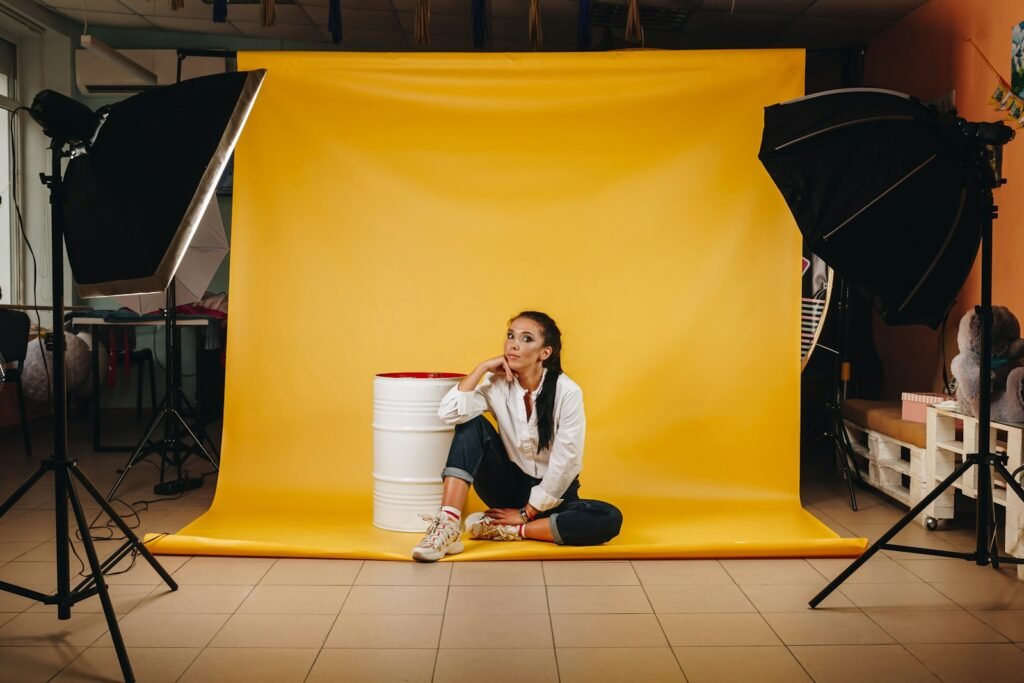
If you are searching for a photography studio Singapore businesses use for product shots, headshots or campaign imagery, the useful question is not which studio to book. It is whether you need a studio at all, and if you do, how many hours of it you actually need. We produce shoots for Singapore SMEs across retail, F&B, professional services and manufacturing, and the pattern that decides whether a shoot day succeeds is almost never the venue. It is whether someone wrote a proper shot list before the lights went up.
Studio hire in Singapore is not expensive relative to the rest of a production budget. A decent space with a cyclorama and a set of strobes can be had for a few hundred dollars for a half day. What is expensive is a day of that studio spent deciding what to shoot, hunting for a missing product sample, waiting for a model who was booked for the wrong call time, or reshooting forty items because nobody agreed the background colour in advance.
This guide covers the three realistic routes for a Singapore business (hire a space, hire a studio-equipped photographer, or build a small in-house corner), what each costs in SGD, what a studio genuinely buys you that a location shoot cannot, which shoots belong in a studio and which are better on site, what crew and equipment to expect, and how to build a shot list that turns a booked day into a usable library.
What a photography studio in Singapore actually is
Studio space in Singapore comes in three broad grades, and the terminology gets used loosely, so it is worth being concrete.
A hire space with a cyclorama. A room, typically 600 to 1,500 square feet, with a curved white infinity wall, blackout, high ceilings, power, air conditioning and a load-in route. Usually rented bare or with a basic lighting kit included. Concentrated in industrial estates around Kallang, Ubi, Paya Lebar, Bukit Merah, Tai Seng and the west, because that is where ceiling height and floor loading are affordable.
A fully equipped commercial studio. The same, plus a working strobe pack set, modifiers, C-stands, a tethering station, a make-up and changing area, a kitchen if it does food work, and often a studio manager on site. This is what most commercial campaign work is shot in.
A photographer's own studio. A smaller space, often 300 to 700 square feet, run by the photographer as part of their business. You do not rent the room, you book the photographer and the room comes with them. This is the most common route for Singapore SMEs and the one most people do not realise is available.
There is a fourth category that is worth naming because it wastes money: the co-working "content studio" with a white wall, a ring light and a phone tripod. It is fine for casual social clips. It is not a studio in the sense that produces a catalogue you can print. We have seen clients book one for a 40-item product day and end up reshooting the whole set six weeks later.
Ceiling height is the specification that most affects what you can do and the one people forget to ask about. Under 3 metres, you cannot get a light high enough for full-length fashion without the stand appearing in frame, and you cannot bounce off the ceiling cleanly. Anything at 4 metres or above gives you real flexibility. If you shoot furniture, bikes, or anything on a plinth, ask for the height before the rate.
What studio space actually buys you
There are only three things you are really paying for, and it is worth being clear about them because each one has a location-shoot alternative that is sometimes better.
Control of light
In a studio you decide the direction, quality, colour temperature and ratio of every light in the frame, and it stays exactly the same at 10am and at 6pm. On location you are negotiating with whatever the window and the ceiling fluorescents are doing. For a Singapore shoot this matters more than people expect, because our overcast-then-glaring weather swings can change the light in an office by two stops within twenty minutes.
A truly neutral background
A cyclorama gives you a seamless, shadowless white that can be cut out cleanly in post. If your product images need to go on a marketplace with a pure white background requirement, or your headshots need to sit in a grid on an About page without one person having a bookshelf behind them, this is the single reason to book a studio.
Consistency across a catalogue
This is the underrated one. A 90-item catalogue shot on a location day will drift: the sun moves, someone bumps a light, the third hour looks warmer than the first. In a studio with a locked set-up and a tethered camera, item 90 matches item 1. When we shoot a full catalogue we mark the floor with tape, lock the tripod, and do not touch the lights, and the difference downstream in editing time is measured in days.
If none of those three things is genuinely required by your brief, you may not need a studio. That is not a popular position with studios, but it is the honest one.
Three routes compared
| Route | Typical SGD cost | What is included | Best for | Main risk |
|---|---|---|---|---|
| Hire studio only, bring your own photographer | SGD 90 to SGD 250 per hour, or SGD 400 to SGD 1,200 per half day | Space, cyclorama, basic lighting, sometimes an assistant | Teams with a trusted photographer who lacks a space | You are paying for room hire on top of a day rate, and someone has to coordinate both |
| Book a studio-equipped photographer | SGD 900 to SGD 2,500 per half day, SGD 1,600 to SGD 4,500 per full day | Photographer, their studio, lighting, tethering, basic retouch | Most Singapore SMEs, most of the time | Their space may be small or fixed in style |
| Full production with hired studio and crew | SGD 4,000 to SGD 15,000 per day | Photographer, assistant, stylist, retoucher, premium space, catering | Campaign, seasonal lookbook, brand relaunch | Overkill for routine catalogue work |
| Build a small in-house corner | SGD 2,500 to SGD 8,000 setup, then near zero per shoot | Backdrop, two strobes or continuous lights, table, tripod, colour checker | High-frequency, low-complexity output such as weekly new arrivals | Nobody owns it, quality drifts, it becomes a storage area |
A note on the last row, because it is the option people are most often talked out of and most often should take. If you launch fifteen new SKUs a month and each one needs three clean pack shots, you will do 540 images a year. At SGD 25 to SGD 45 per image through an external service, that is SGD 13,500 to SGD 24,300 a year. A properly specified in-house corner costs SGD 2,500 to SGD 8,000 once, plus somebody's time.
The catch is real though. In our experience an in-house setup only survives if one named person owns it, there is a written and photographed set-up sheet so it can be rebuilt identically, and the camera settings are recorded. Where those three things exist, in-house corners work well and last years. Where they do not, we find them nine months later folded behind a shelf, and the business has quietly gone back to paying per image.
Which shoots need a studio and which do not
This is the decision that saves the most money, so here it is directly.
| Shoot type | Studio or location | Why |
|---|---|---|
| Ecommerce pack shots on white | Studio | Cutout-ready background and catalogue consistency are non-negotiable |
| Corporate headshots for a team | Either, studio preferred | A portable backdrop on site works, but a studio gives cleaner separation and no room noise |
| Team culture and office life | Location | The whole point is the real environment |
| Food for menu and delivery platforms | Studio or a controlled corner of the kitchen | Needs consistent light and fast turnaround while food is fresh |
| Jewellery, watches, cosmetics | Studio | Reflection control needs enclosed light shaping you cannot do on site |
| Furniture and large homeware | Studio with height, or a styled set | Needs space and ceiling clearance |
| Factory, workshop, manufacturing | Location | The machinery and scale is the story, and you cannot move it |
| Property, F&B interiors, retail space | Location | The space is the subject |
| Founder and leadership portraits for press | Either | Studio for a clean library, location for narrative and context |
| Model wearing apparel, full length | Studio with 4 metre ceiling | Needs height, movement space and repeatable light |
The general rule: if the background is meant to disappear, book a studio. If the background is part of the message, go on location. Most Singapore businesses need some of both, and the mistake is treating it as an either-or decision made once a year. We recommend planning a year as two studio days and two location days rather than four of the same thing, because our clients almost always find they are short of exactly the type they did not book.
Rates, and what actually drives them
Studio-related quotes in Singapore vary widely, and the variation is not usually about the photographer's skill. It is about four things.
Volume and complexity of setups. The unit that matters is not the item, it is the setup. Forty items shot on the same white background with the same light is one setup and a fast day. Eight items each needing a different styled arrangement is eight setups and a slow day. When we scope a product photography shoot, we count setups first and items second, and clients are often surprised that adding thirty more SKUs to an existing setup costs very little while adding two new setups costs a lot.
Retouching depth. Basic retouch (crop, straighten, colour correct, background clean) is usually included. Advanced retouch (skin work, compositing, shadow reconstruction, liquid or reflection work on glass) is a separate line and often priced per image at SGD 15 to SGD 80 depending on complexity. Ask which you are getting. A quote that looks cheap frequently has basic retouch only, and a quote that looks expensive is often including the retouching you were about to pay for separately.
Crew size. A solo photographer can handle straightforward portraits and simple pack shots. Anything involving models, wardrobe, food, or more than about six setups a day realistically needs an assistant, and often a stylist. An assistant typically adds SGD 250 to SGD 500 a day. A food or prop stylist adds SGD 600 to SGD 1,500 a day. This is not padding. A stylist on a food shoot is usually the difference between usable and unusable.
Usage and licensing. Most Singapore SME shoots are quoted with broad usage included for owned channels. If the images are going into paid media at scale, out of home, or a regional campaign, expect a usage line. Clarify it in writing before the shoot, not after you have fallen in love with a frame.
Typical half-day and full-day ranges we see quoted in the Singapore market:
Half day, solo photographer with their own studio, straightforward brief: SGD 900 to SGD 2,500.
Full day, solo photographer with their own studio: SGD 1,600 to SGD 4,500.
Bare studio hire, half day: SGD 400 to SGD 1,200 depending on size, cyclorama and equipment included.
Bare studio hire, hourly: SGD 90 to SGD 250, usually with a two hour minimum.
Assistant: SGD 250 to SGD 500 per day. Stylist: SGD 600 to SGD 1,500 per day. Model or talent: SGD 400 to SGD 1,800 per half day depending on profile and usage.
A half day in Singapore is conventionally four hours including setup and pack down, not four hours of shooting. This is the single most common misunderstanding in booking, and it costs clients about forty minutes of shooting time on every half-day booking where they assumed otherwise. Ask explicitly whether setup is inside or outside the billed window.
Equipment and crew: what to expect and what to check
You do not need to specify equipment, but you should be able to recognise a properly resourced shoot. Ask about four things.
Lighting. Studio strobes with modifiers, not continuous LED panels alone, for anything involving stills of products or people at high resolution. Continuous light is fine for video and for small tabletop work but struggles to overpower ambient and to freeze movement.
Tethering. The camera should be connected to a laptop with images appearing at full size as they are taken. If you are attending the shoot and approving frames on the back of a camera, you are approving a thumbnail. Tethering is standard on any commercial job and its absence is a signal.
Colour management. A grey card or colour checker shot at the start of each setup, and a calibrated monitor for editing. Without it, your product's actual colour is a guess, and colour returns on ecommerce are expensive. When we audit a client's existing image library, mismatched colour across shoots done at different times is the most common reason a catalogue looks amateur despite every individual frame being technically fine.
Backup and handover. Dual card slots in camera, a copy taken off the cards before anyone leaves the building, and a stated delivery format. Agree file naming to your SKU codes in advance. That one request saves more downstream admin than anything else on this list, and almost nobody asks for it.
On crew, the honest position is that most SME studio days need one photographer and one assistant, and the assistant is the highest-value SGD 350 you will spend. They handle set changes, product prep, steaming, tape, and keeping a running log, which means the photographer keeps shooting. Without one, the photographer becomes their own stagehand and your effective shooting time drops by roughly a third.
A common mistake we see
A common mistake we see is businesses shopping hard on studio quality and price while arriving with no shot list.
The logic is understandable. The studio is the visible, comparable, priceable thing. You can look at three spaces, compare hourly rates, and feel like you made a decision. The shot list is invisible work that nobody bills for, so it does not get done, and the shoot day absorbs the cost instead.
In reality, for the great majority of Singapore SME shoots, the studio is not the bottleneck. The unprepared brief is. A SGD 500 half-day space with a fully planned day will out-produce a SGD 1,500 space where the first ninety minutes are spent deciding whether the product should be shot on white or grey.
Here is what an unplanned day actually looks like, and we have sat through enough of them to describe it accurately. The first forty minutes go on setup, which is normal. Then twenty minutes on unpacking and inspecting samples, three of which turn out to be the wrong colourway. Then a discussion about whether the hero angle is three-quarter or straight-on, which involves someone messaging a director who is in a meeting. Then a first setup that gets abandoned after eleven items when someone realises the props do not match the brand refresh. By lunch, roughly a quarter of the intended output exists. The afternoon is spent rushing, which is where the inconsistency creeps in, and the retoucher then spends two extra days fixing what the rush created.
None of that is the studio's fault, and a better studio would not have prevented any of it.
The second version of this mistake is subtler: booking a studio day without knowing where the images will be used. Images have aspect ratios and crop requirements determined by their destination. A frame composed beautifully for a 3:2 print is useless for a 9:16 story and awkward in a 1:1 grid. We plan destinations before setups, because the destination determines the composition, and shooting for social media content requires deliberately leaving headroom that a print composition would consider a mistake. Deciding this on the day means either reshooting or cropping into a compromise.
We recommend a simple rule. No studio gets booked until the shot list is written, reviewed by whoever will use the images, and signed off. If the list is not ready, move the date. A postponed shoot costs a rebooking fee. An unplanned shoot costs the whole day.
How to build a shot list that protects the day
A shot list is not a wish list. It is a schedule with a running time.
Group by setup, not by product. Every change of background, light or camera position costs 15 to 30 minutes. Order the list so that all items sharing a setup are shot together, even if that means shooting products from three different collections back to back.
Time each setup honestly. Assume 20 minutes to build a setup, then 3 to 6 minutes per straightforward item, 10 to 20 minutes per styled item, and 15 to 25 minutes per person for portraits including their settling-in time. Add the numbers up. If they exceed your booked hours, cut the list rather than hoping.
Mark hero versus catalogue. Heroes get time and styling. Catalogue items get speed and consistency. Trying to make every frame a hero is how a 60-item day becomes a 25-item day.
Specify the crop and the destination for every hero. Website banner, product page, paid ad, print. Note the aspect ratio next to each.
Name your files in advance. Bring a spreadsheet with SKU codes in shooting order. The photographer or assistant logs frame numbers against SKUs as you go. This turns file handover from a two-day guessing game into a fifteen minute job.
Prepare the products before the day, not on it. Steamed, cleaned, price stickers removed, packaging opened, correct colourways confirmed, spares brought. Product prep is the single most common cause of overrun.
Nominate one decision-maker who will be present. Not a committee, and not someone reachable by message. One person, in the room, who can say yes.
Where the shoot supports a broader campaign, we build the shot list backwards from the content calendar, so that every image has a named slot it will occupy. That is how a content marketing programme stops running out of assets in month four, which is when most of them do.
Case study: a Singapore skincare brand that halved its cost per image
One Singapore retail business we worked with, an independent skincare brand with about 70 active SKUs, was spending roughly SGD 6,800 per quarter on product imagery and consistently running short of assets for campaigns.
What was happening: they booked a premium studio at SGD 1,400 per half day, roughly six times a year, arriving each time with a rough list assembled the previous evening. Output averaged 22 finished images per half day. Retouching was quoted separately at SGD 28 per image because the frames were inconsistent and needed individual correction. Roughly one in five images was rejected internally, usually for a colour or shadow mismatch against previously published shots.
What we changed across one quarter:
We moved them to a smaller photographer-owned studio at SGD 950 per half day with the photographer, assistant and basic retouch included.
We built a written setup sheet with a diagram, light positions, camera settings, and a photograph of the completed set, so that every session started identically.
We wrote the shot list two weeks ahead, grouped by setup, timed, and signed off by the person running their marketing.
We introduced SKU-coded file naming logged live during the shoot, and a colour checker frame at the start of each setup.
We required product prep to be completed and photographed the day before.
The results across the following two quarters:
Output rose from 22 to 51 finished images per half day, an increase of about 130 percent.
Internal rejection rate fell from about 20 percent to under 4 percent.
Separate retouching spend fell from about SGD 620 per session to about SGD 90, because the frames were consistent enough for batch correction.
Quarterly imagery cost fell from about SGD 6,800 to about SGD 3,100, a reduction of roughly 54 percent, with more than twice the assets delivered.
Time from shoot day to usable files fell from 11 days to 4 days.
Product page conversion on the 30 SKUs that received new consistent imagery rose from 1.9 percent to 2.6 percent over the following quarter, with no change to pricing or paid spend.
The cheaper studio produced better images. Not because it was better, but because the day was planned.
Field Notes
Numbers from our own production work with Singapore businesses.
Across 14 SME studio shoots we produced between 2024 and 2026, the median output on a properly planned half day was 44 finished images, against 19 on days where the shot list was written in the final 24 hours. The planning gap, not the venue, accounted for almost all of that difference.
Setup changes cost a median of 22 minutes each in our own timing logs. On a four hour booking, four unplanned setup changes remove roughly 90 minutes of shooting.
Product preparation overruns appeared on 9 of those 14 shoots. Median lost time was 35 minutes. In every case the products had been sent directly to the studio without being checked.
Across 6 corporate headshot sessions, we schedule 15 minutes per person and the median actual time was 13 minutes, but the first three subjects of any session consistently took 20 to 25 minutes. We now schedule the most camera-comfortable people first, which has cut total session time by roughly 18 percent.
Where clients adopted SKU-coded file naming logged during the shoot, median handover time from shoot day to delivered files fell from 9 days to 4 days across 5 engagements.
In-house studio corners: of 4 we have specified for clients at a setup cost of between SGD 2,900 and SGD 7,400, 3 were still in active weekly use after 12 months. The one that was not had no named owner.
Frequently asked questions
How many hours should I book for a first studio shoot?
Book a full day for your first shoot if you have more than three setups, even if the list looks like it fits a half day. First shoots always run long because nobody has established the working rhythm, the brand's preferences are being discovered in real time, and approval takes longer than it will next time. Once you have a written setup sheet from that first day, subsequent shoots of the same type will genuinely fit a half day. We have seen the same catalogue take seven hours the first time and three and a half the second time, with no change in output.
Should I hire the studio and the photographer separately?
Usually no. Booking a photographer who has their own studio is simpler, cheaper and removes a coordination risk, and it covers the great majority of Singapore SME needs. Separate hire makes sense in three situations: you have a photographer you specifically want who works out of other people's spaces, you need a space with a feature theirs lacks such as a 5 metre ceiling or a working kitchen, or you are running a large crew that needs the room for a full day including hair, make-up and wardrobe. Outside those cases, the added coordination is not worth it.
Can I use the same shoot for both photography and video?
Yes, and it is often efficient, but plan it as two things sharing a day rather than one thing. Video needs continuous lighting rather than strobes, so lights change between the two, and that transition costs time. It also needs different framing, sound consideration and usually a second operator. We generally block stills in the morning and moving image in the afternoon, and where a project needs both properly, we scope video production as its own line with its own crew rather than assuming the photographer will cover it.
How do I keep imagery consistent when I change photographer?
Build and keep a setup sheet. It should contain a diagram of light positions with distances, the modifiers used, power settings, camera height and distance, lens and focal length, aperture and shutter, white balance, background material and colour, and a reference photograph of the completed set and one finished frame. Hand that to any new photographer and ask them to match it. This is ordinary practice in commercial production and it is the reason catalogues from large brands stay consistent across years and multiple shooters. Almost no Singapore SME has one, and it costs nothing to create at the end of a shoot you have already paid for.
What should I do with the images after the shoot?
Decide before the shoot, and it will change what you shoot. Product images go to product pages and marketplace listings, portraits go to team and About pages, styled hero frames go to campaigns. Store the delivered files in one named library with SKU-coded names, keep the full resolution originals, and export the sized versions you actually use rather than uploading originals to your site. Oversized image files are one of the most common causes of slow pages we find when auditing a website design build, and it is a self-inflicted problem created in the twenty minutes after a good shoot.
Booking a studio shoot that earns its budget
Studio photography is worth paying for when you need controlled light, a clean removable background, or consistency across a catalogue. If your brief needs none of those, spend the money on location work instead. If it needs all three, book a studio, but book the planning first.
The order that works: define where each image will be used, write and time the shot list, prepare products or people, agree file naming, then book the space and the photographer to fit the day you have designed. Done in that order, a modest half day produces more usable assets than a premium full day booked in the other order. That is not a claim about studios. It is a claim about preparation, and we have watched it hold across every shoot we have run.
If you want a shoot planned this way rather than improvised on the day, our team scopes and produces corporate photography in Singapore from shot list to delivered library, and the wider production team handles everything from studio catalogue days to on-site brand work. We can also plug the output straight into your social media management and organic social schedule so the images are actually used, and make sure your images and business listings support your local search visibility. You can see who we are or get in touch to talk through a shoot.

Natasha Tan is the founder of Digital Marketing Singapore, a full-service SEO and digital marketing agency based in Singapore. With hands-on experience across SEO, paid media, and content strategy, she works directly with Singapore businesses to build organic visibility and generate consistent leads. Natasha specialises in the Singapore market — including local search behaviour, PDPA compliance, and government grant navigation for SMEs.



